Showing posts with label Culture. Show all posts

Tuesday, November 9, 2010

Villa de Leyva

October 12th to 14th

Ask the locals in Tunja about 'Villa de Leyva' and they all go misty eyed and talk of a hidden paradise in rapturous tones. It's a 700 metre climb back the way we came, but that's never stopped us before.... so another diversion....

Luckily we've got our newly enlarged visas in our back pockets!

The ride is another doozy as we climb sharply out of Tunja through massive agrarian landscapes backed by ever rising emerald hills....


Higher still the land tends to brown as the peaks are too steeply angled to delay rainwater long enough to sprout vegetation. From this vantage we can see the road slicing along the ridge as it drops into the next valley....


And drop it does! We are getting a bit confused after expecting a full day of climbing as we continue to fall and there is no longer much road between us and our destination. Our descent is confirmed as we stop to admire the scenery and I am instantly swarmed by blood sucking black-fly. Above 2500m we have been free from such attention as mosquito and other nasties cannot scale such heights.

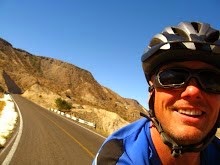
We continue to zoom down a thin line of tarmac carved along a rock wall...


Racing past agave plants flowering massively and dwarfing nearby telegraph poles....


Suddenly we hit town and decide our guide book must have got it wrong. The dramatically rising air temperature confirms our descent, and we conclude that Villa de Leyva is 700m lower, not higher than Tunja. Oh well - an easy day today and we can worry about regaining all that lost altitude later.

Villa de Leyva; a Paradise....
Hmmm....
Well I guess it all depends on what you are looking for. The scenery of the ride is far more interesting than the barren scrubby hills surrounding the town and we are definitely not impressed by the authentically ancient cobble-stone streets that threaten to destroy our bikes and rattle our fillings free from our teeth.

We attempt to find cheap digs and start to understand the town's appeal to the city slickers of Tunja and nearby Bogota. Most accommodation is strictly not cycle tourist friendly. It's more your spa retreat, room service, full manicure and facial type of crowd with prices to match. We take a deep breath as we leave the first couple of places but eventually find a family run business that has an outhouse with spare beds behind their lovely (and way beyond our price range) hotel. It's a third of the price at 30,000 pesos.
OK that sounds a lot, but it's about $US17 and pretty good value!

We don hiking boots for the uneven stone streets and explore a bit more.

Villa de Leyva is a throwback. Established in 1572, it was declared a national monument (like the whole town is the monument) in 1954 and nothing modern is allowed to exist. It's all rather jolly quaint!

Whitewashed colonial houses and the Parish Church surround what is reputedly the largest plaza in all of Colombia....


All the streets around the town centre are painfully cobbled and extremely lighty-brighty in their immaculate, eye melting whiteness.


Window shutters are traditionally wood carved and uniformly brown or green....


Roof tiles are ordered ranks of inoffensive pale salmon, neatly laid and not-a-one broken.
As a town it's all incredibly well behaved, and surprisingly, as a graffiti virgin I feel just a slight itch to run amok with a brush and some colour. It's not in my nature, but all those pristine expanses of immaculate whiteness is acting like a bland rag to a bull with a spray can.
Somebody stop me!

We race past all the twee souvenir shops in a rush to get away before something goes wrong and hike out into the hills.

The town is a lovely museum and I can see the appeal for rich city folk on a pampering weekend, but for us the hills above the town provide an escape from a theme park into some fine hiking country. Trails skirt along rock crags....


and are lined by weird combinations of agave cactus and pine....


The air is warm and loamy, with the scent of resin heavy and sweet on the breeze. Spanish moss drapes the trees and giant bromeliads sprout short legs and wild sprays of green - like a huge pineapple - wildly enthusiastic....


Those obsessively correct tiles make for a fine view back over the town's rooftops to the patchwork hills behind....


Maybe I'm being a little unfair. Villa de Leyva is undeniably pretty - maybe even a little dainty, but we do find a fairly hard hitting museum to the martyrs of the Colombian fight for independence. Antonio Ricaurte, a Captain in Simon Bolivar's army was born here and there is stunning original artwork of brutal scenes endured by the freedom fighters....


There is a (surprisingly) interesting Palaeontology museum just outside of town with models and exhibits from when this whole region was a giant pre-historic inland sea. Even more incredible when you consider the whole area has now been elevated to over 2000m (6,600ft) by the rising Andes.

Villa de Leyva also has tons of nice bars and restaurants hidden away in old colonial court yards behind those bland white facades....


Changed my mind...
I kind of like the place really.
And I'm sure your mother would too....

Wednesday, September 22, 2010

Cartegena

27th Aug to 1st Sept

It's a bit sad to leave Ludwig, Rolli and the rest of the Stahlratte crew behind as we take a short dinghy ride to shore with our bikes and kit. Riding into the old town of Cartegena, the very first Colombian to talk to us is a guy who jumps out in the road offering us drugs! Welcome to Colombia - good to see all the old stereotypes alive!

The town centre is carnage with narrow streets thronging with hoards, all weaving in and out of hand carts and yellow taxis that blare horns incessantly. We ride the wrong way up a couple of streets to a hotel where some of the others from the boat are staying; but it is full.

I'm sure I didn't buy any drugs off that guy, but I must be hallucinating when we see a guy dressed as a horse throwing high-kicks at a group of passing school children. They scream and squeal in delight running out into the traffic choked street.

We hole up just outside the old city walls in "Getsemeni" and head out to explore this mad place - our first sight together of South America. Cartegena is an old, colonial walled town that prospered as a major Spanish port in the 16th Century. Old silver money just drips off the beautiful building facades. Nowadays, some are showing signs of disrepair as the money dried up and left; this block is the thriving red light district where painted ladies stretch latex to bursting point as they pout and whisper enticements to the crumbling, hourly-rate rooms upstairs....


Heading on inside the walls that South American vibrancy hits you immediately. Plaza de los Coches is alive with dancers writhing to maniacal drumbeats. They dance the traditional steps of the "Kalimari" tribe who inhabited this coast before Spain came. They worshiped a serpent god and the dance is seductive, sexy and sinuous reflecting the demon spirit of the snake. It's too fast to capture....


The streets are similarly alive with vendors of all kinds pushing carts of fruit, deep fried foods or coffee and cakes. 'Minutos' are everywhere - guys sitting behind trestles with mobile phones for hire. For 100 Pesos ($0.05) you can buy minutes and they will place the call for you. In between calls they gamble on dice or the flip of a coin. The excitement is too much for one onlooker....


We meet up with all 20 fellow passengers from Stahlratte in their hostel's roof top bar and enjoy a couple of cold ones in sight of Fort San Filipe that once protected the city from English pirates....


Later we hit a reggae bar for some live music. We leave at around 1:30am but some of the others see the dawn in... Cartegena is a party town.

There are some excellent museums in town and we head to the Naval Museum next day which has a history of the Spanish conquest displacing the local tribes in this area. The main room has some fantastic models of the ongoing struggle to defend the city during the 16th to 18th centuries. The treasure hoards of Peruvian silver attracted increasingly more determined fleets from Britain and France (including Sir Francis Drake) who often carried out pirate raids rather than risk outright war closer to home. There are descriptions of the battles and a timeline for the building of ever more elaborate defensive walls and forts around Cartegena.

Inside the walls, Cartegena is definitely less seedy than Getsemeni and there are tons of upmarket eateries and boutique hotels around the open plazas....


They obviously cater to a different budget than ours so we head back to the cheap seats and find a bar doing an excellent curry. Oh I do miss a good curry! After that we head on to a Salsa bar and meet up with the crew and our Stahlratte ship mates again.

On the last Sunday of the month, most city attractions are free so we head en-masse up to San Filipe Fort to see the canons and imagine battling scurvy sea dogs come-a-plundering!


It's all a little hard to imagine with all that modern skyline in the background though. The Fort itself is impressive with tunnels running like an underground warren, but as a museum it is not. There is no information of any kind and it definitely pays to visit the Naval Museum first.

As it a free day we head to the gold museum next and learn how rare metals like iron and steel were here but that gold was commonplace. Rumour has it that pure nuggets could be found just lying in rivers waiting to be picked up! Consequently it was used for everything from beautiful jewelery and ornamental dress; right down to commonplace objects like weights and fish hooks....


You can imagine how the Spanish must have felt when they washed up on shore amongst all this wealth!

There is a film about the "Zenu" - an inland tribe that built vast canal networks over a 2000 square mile area to control river flooding around 2000 years ago. They slowed the advancing water and used the river and it's silt to irrigate and fertilise vast tracts of land. It is a feat that is beyond modern engineers and parts of Colombia's central valley suffer from uncontrolled flooding today!

Plaza Trinidad is a local's hangout and the boat crew head down for Sunday nights. There is a 5 piece band just jamming and they are really, really good. A stilt walking dancer joins them followed by a juggler with flaming torches. There are street carts laden with food and the local shop sells cold beer which you can carry out - it's a really chilled atmosphere.

A typical Sunday night out with friends....


50 kilometers outside Cartegena is "Volcan de Lodo el Totumo" so we take a tour bus with our group. The volcano doesn't look that impressive - just a 15 metre cone, but it is made from mud spewed up to the surface under pressure. The lukewarm mud is supposed to have therapeutic properties and it's a weird feeling slipping and sliding into this thick, oily bath....


You feel a bit like a cork bobbing uncontrollably high in the water and you just can't move. There are 'helpers' who push you into place where, if you are still, you hardly feel the mud at all and you get this weird sensation of floating in space. If you do try and move, you get a strange feeling of overbalancing as your body flails about and you start to roll forward.
Mud does not taste good!
Your skin does feel amazing afterwards though and you can get a massage for about $1.50. Next it's off to the lake to wash off and there are washer women who are more than happy to help. You have to be quick to stop them whipping off your shorts underwater and giving you a good rub down!

We return via a golden sandy beach where a fish lunch awaits us.

Cartegena is alleged to be the most beautiful of all Colombia's cities and I can well believe it. It's not just the buildings either, the people are warm and friendly as well. True, in some parts of Getsemeni after dark it can get a little edgy and there are whispering spivs on many of the street corners, all 'trust-me' smiles and shifty eyes. Mobile phone attached to ear, they promise they can get you anything..... ANYthink (nod, wink....).

But alongside the more 'adventurous' side of life, it's also a place where you could spend a couple of hundred dollars a night in a boutique hotel and dine in fine style in an expensive gourmet restaurant then stroll amongst the walls looking at the ocean and admiring the incredible architecture. It's a real mix!

You could spend days just wandering here. There are numerous old plazas, churches and municipal buildings, plus the street scenes are vibrant and chaotic and ever changing.

A couple of images around town...

A scene straight out of the 16th century....


Cafe culture....


With ever present street vendors and music....


Ancient defenses - modern hangout....


Classic lighting....


Modern art....


The question is.... does life imitate art or does art imitate life....


Wednesday, September 8, 2010

The Many Faces of Panama City

August 14th to 18th

We pause after crossing the Bridge of the Americas to calm ourselves – it's was a pretty hairy ride....


We want to stay in the old town and the road to Casco Viejo takes us through an overpopulated slum area and the locals tell us to “ride fast, don't stop”; excellent advice.


Panama City has a long history, and over time, has evolved into a real mixture. In the 16th Century, it was a massively important port where Spanish silver plundered in the high Andes of Peru was off-loaded before the arduous 50 mile trek overland to Portobello. From here ships could make their way over the Atlantic and back to Spain with their treasure. This route saved thousands of dangerous miles navigating Cape Horn around the Southern tip of Argentina and formed the route map for the famous Panama Canal that was to come 400 years later.


Originally Panama was located 5 miles East of the present centre and was relocated when it was sacked by Henry Morgan, a swashbuckling Welsh privateer tempted by all that Andean silver in 1671. The city was rebuilt within strong defensive walls to dissuade Henry and his marauding mates from returning – hence the name “Casco Viejo” which means “Old Compound”.


As a consequence of all the trade passing through, beautiful colonial style buildings were constructed and the town gained a certain grandeur reflected in the water front housing....


And also the incredible plazas with ornate statuary and the grand 'Hotel Colonial'...


This statue in 'Plaza de la Independencia' represents the signing of the treaty allowing Panama it's independence after separating from Colombia in 1903.


These are the grand bits. Much of the rest of Casco Viejo is a dilapidated collection of disused relics that are slowing turning to rubble under the destructive attention of weeds and tree roots.


Squatters openly occupy many of the buildings and you can see bare wires spliced into the street lamps that illegally power flickering TV's that illuminate the gloom of derelict buildings at night....


It's a slightly surreal vision; some kind of dystopian future where a great wrong has come to pass and a lone face stares from a tattered upstairs windows. He surveys the scene like a Charlton Heston figure in the Omega Man - “The last man”. Maybe that's going a bit far, but walking through this rotting capital city does conjure up that illusion.


Today many of the buildings are undergoing redevelopment or are about to as money floods back into this quarter of the city. Others sadly will just rot into dust and crumble leaving toothless gaps between the newly renovated bars and restaurants.


Across the bay you can see where the money and the developers are coming from. After gaining full control of the Panama Canal from the US in 2000, Panama has been booming and both local and foreign money has poured in.


Like a mirage rising across the bay to taunt the dregs that scratch a living over here, a new city has risen – newer and more sparkly than could ever have been imagined 20 years ago....


Boats in the harbour at low tide look as if they attempted an impossible voyage to this gleaming new world; but were stranded in futility....


Whilst a machine operator seems to stop and survey the transformation he has wrought....


Running between the old and new cities is Avenida Central, a pedestrianised shopping district that does more than just connect these two locations geographically. It seems to connect them in time, having a distinctly modern Central American feel that allows you to transition from a Colonial era of conquistadors and galleons of plundered silver to the space age of towering glass and steel....


It's typically bustling, chaotic, raucous and energetic. Music assaults the ears from wide open shop fronts. Street vendors distract to attract your attention. The sweet smell of the juice blenders mixes with the meaty aroma of the hot dog carts. A blast of cold air freezes you as you pass an upmarket clothes shop, then the warm wet tropical air envelops you once more as you move on.


Locals huddle in corners around squares of cardboards – arenas for dice and cards. Friendly, they call you over and encourage you to lose a dollar or two. More serious are the homemade boards of chess or checkers with coloured pieces taken from different soda bottle tops....


Roads seem to have just been laid down on top of each other - anyplace there was room and traffic is 'entertaining'....


Then, suddenly you are in Miami!


Dropping down to the newly formed boulevard you could be forgiven for thinking that a short walk had taken you across a continent. When was the last time I saw a roller blader in Central America, or a cycle path back-dropped by a glass skyline....


The new city is distinctly aspirational, with upmarket car dealerships and million dollar penthouses.

Entry level apartments with low level city views still command $200,000 price tags – an astronomical sum for Panamanians and quite a bit for ex-pats too. I can't help feeling that there is a bit too much optimism crackling in the air and that a developer somewhere is going to take a haircut now that the spray of foreign money has dried up a bit.


But then, what do I know. The building continues apace. Another 3,000 dreams of fine living reach for the skies....


Across the bay, far out to sea, the great Pana-Max cargo ships stack up in a queue all waiting to push through “The Canal” - the engineering marvel that is the lifeblood of this hungry city. Like a slow motion parody of airliners circling a busy airport they wait for their call....


Each will pay on average a quarter of a million dollars to pass through to the Caribbean and on to the Atlantic and I can see maybe 30 of them. Queues are long as that $250,000 is cheap compared to the 3 weeks of ship time saved by rounding Cape Horn; so the canal runs at breaking capacity. A national referendum gave an almost unanimous backing to ambitious expansion plans that allow this waterway to take ever more gargantuan ships. Building work is already underway to update this 100 year old superstructure and this important revenue stream should increase if all goes to plan.


Maybe, just maybe the property developers here have got it right and each of those new homes in the sky will find a deep-pocketed buyer. There is a contagious confidence in the air and this is definitely a place to return to in a few years to see how the story unfolds....


Saturday, May 22, 2010

Masaya and Granada

April 17th to 21st

20 kilometres outside Managua, the town of Masaya is the centre of the Nicaraguan arts and crafts trade. The old market is home to thousands of artists famous for a quality hammocks, geometrically decorated gourds and pottery plus a wealth of leatherwork and basketry.

But thats not why we're going there.

Like the face of a pimply teenager, Nicaragua is dotted with an impressive 21 volcanoes. The statistic is all the more impressive considering the country is about the size of New York State.They stretch in a south easterly line from the Honduran border, across to Costa Rica and the volcano here at Masaya is the most active of them all. Just outside the town we pass the giant crater lake created in a huge explosion around 6000 years ago. Drinks are outrageously overpriced at a beautiful restaurant overlook, but the view is well worth the money....


We plan to head to Masaya town, drop off our bags in a hotel and ride back to climb the volcano but just as we arrive, we bump into another laden touring bike and stop for a chat. Sean and Ingrid, a British couple are travelling south from Alaska, nothing that unusual so far, but they are doing it on a tandem so they can bring their eight year old daughter Kate along with them. Sean does the steering while Kate does the pedaling from the back of the tandem. In order to carry all their gear including books for Kate's schooling, both the tandem and Ingrid's bike tow trailers making them about the longest bicycling convoy I have ever seen....


They were just heading out of Masaya after debating whether to visit the volcano or not but change their plans when we say we are going. So we return to the hotel they checked out of just 20 minutes earlier, dump our gear and head back to the 'Parque Nacional Vulcan Masaya'. Like them we had debated about visiting after a less than inspiring write up in guide books, but our arrival reveals an absolute gem of a visitors centre. One of the guides explains the area's geology over a 3D map showing the complex of craters and mini lakes and there are other models and exhibits on all things volcanic. It's probably one of the best educational centres I have been to anywhere in the world. It's also a safe haven to kill an hour or two when the clouds burst in an unexpected deluge that changes the placid skies to a rampant waterfall.

When the air becomes dry and see-through once again, we venture out and ride a steep track up to the volcano's rim. The air is thick with throat stinging sulphurous gases and guides have supplies of gas masks they can dole out should the volcano belch back into life or the wind change direction. Looking at the scene it's no wonder Spanish priests used to believe this was The Gate to Hell itself and they would come here in the 16th to prevent Satan from escaping. One priest allegedly mistook the glowing lava for molten gold and set off to collect some. Maybe God does indeed protect the weak and foolish as he apparently survived this misguided attempt at riches.

It's hard to judge scale, but this is a whopper....


This whole area used to be one gargantuan volcano which covered several square miles, the cone soaring nearly 3 miles (14500 feet) in height. Then, 6000 years ago there was a massive explosion which blew the mountain away and flattening the entire area. Now there are several smaller craters where the land still boils and erupts and also the huge Lake Masaya sitting within the rim of the original volcano. Ingrid, Sean Sue and Kate set against one of the newer (much smaller) crater rims...


After a night in Masaya, we set out as a convoy to cover the 10 miles or so to Granada. Normally we get enough attention riding just as a couple - riding with guys on a tandem hauling trailers, especially with the diminutive figure of Kate on the back.... well that just floors people.

Founded in 1524, Granada rapidly prospered as a rich trade centre due to it's location on Lake Nicaragua. Whilst seemingly land locked, this enormous lake has an outflow to the Caribbean Sea via the San Juan river allowing huge cargoes to be transported by ship. It's rivalry with Leon erupted into full blown civil war in the 1850's whereupon Leon enlisted an American adventurer, William Walker to help out against Granada. He duly took the city, betrayed Leon and then set himself up as president of the entire country. After reintroducing slavery, changing the official language to English, mortgaging half the country for his own personal gain he then set about invading Costa Rica. At that point people got tetchy and kicked him out, but not before he managed to burn the city to the ground.

Today Granada is a striking collection of restored colonial buildings and more modern copies like the central cathedral....


As Nicaragua's premier tourist town, the main streets are pedestrianised which is unusual in Central America - doesn't stop people of bikes though....


The touristic centre is colourful, the lively plaza hosting a band whilst locals and travelers alike watch and dance. Bars and restaurants compete along traffic free streets, outdoor tables and chairs a haven for diners and people watchers. It's lively and colourful...


Old doorways, modern business....


Strolls through back streets take you past old churches and single story adobe houses, the mountains and cathedral dome an ever present backdrop....


During the heat of the day, Kate catches up on her school work and Sue just cannot help the maths teacher in her coming out to torture the poor girl. She inflicts a couple of hours of fractions and decimal sums on her before we head out for a Chinese in the cheaper streets away from the tourist trap.

Sean, Ingrid and Kate bid us farewell and head off the next day, but we stay to explore a bit more. Nice meeting you guys and hope we can catch up somewhere south of here...

Walking out of town, the mile or so to the lake reveals a rougher edge behind the freshly painted facade. Open sewers cause the nose to crinkle and instead of high price bars; beggars and rubbish now compete to line the streets. The malecon or walkway along the lake shore could be amazing, but the park and restaurants are showing signs of neglect and a lack of maintenance as they slowly slip into disrepair.

Back in town there is a real mix of the old and the new and some of the back streets are just beautiful.


It really is a mix though. Nicaragua after all the troubles of recent times has over 50% unemployment. There is state provided education, but it can be sketchy in places and poorer families often send their children out to beg to provide money where parents cannot find work. Granada with it's fat wallet carrying gringos acts like a magnet and having a white face paints you with a target.

We are really torn. Hearing their stories is heart rending. Some are genuinely sad cases, others are patently just fronts to garner easy money from rich westerners. By comparison, we are massively wealthy and it is easy to appease your conscience and just give to them all. But underneath that there is always the nagging doubt that by giving, you just encourage parents to keep children out of school and to squander their one chance to a better life. It is a tough question, particularly in a country where an education doesn't easily lead to a job in a place where half the people cannot find work.

In the last couple of years the EU and the US has withheld over $200 million in aid due to irregularities at the last election. Even Oxfam has pulled out of Nicaragua because corruption meant that aid was not getting through to the people that needed it. The current president Daniel Ortega was supposed to be the saviour of the people - a new dawn, but one man we speak to talks of more revolution if he were re-elected after changing the constitution to allow him to run again.

You just can't help feeling this is a country just struggling back from the brink after the last few decades, but whether it follows countries like Costa Rica to a better future is still open to debate...


The sun sets over this beautiful old historic city and tomorrow we leave it behind and head down the lake shore. We've a ferry to catch to the Volcanic island of Ometepe....